Why classic fairy tales still expose today's harshest truths
Fairy tales may be for children, but the lessons they teach echo in doctors' wards and flotillas alike.
From the earliest age, children encounter stories that are as much moral instruction as entertainment. Fairy tales, in particular, operate as the first ethical scaffolds: they teach courage, prudence, honesty, and the consequences of folly.
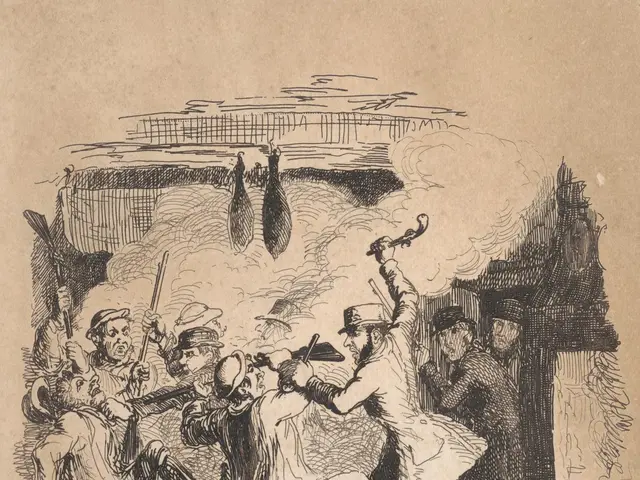
There was a book I was particularly drawn to as a child which may say something about my upbringing compared to the average kid in my circle. Regardless, Struwwelpeter (1845), written and excellently illustrated by Heinrich Hoffmann, a psychiatrist trained in the medical profession, exemplifies this dual function in a potentially trauma-inducing way.
Hoffmann's cautionary tales, often grotesque, instil early ethical reasoning by showing cause and effect in stark terms: a boy who cannot stop sucking his thumbs is punished when a roving tailor chops them off with giant scissors; a girl who plays with matches accidentally sets herself ablaze and burns to death. Only her cats mourn her. And so on.
These moral seeds find echoes in professional life, especially in fields like medicine, where ethical judgment is critical. A recent study of 46 junior doctors explored how they acquire phronesis - practical wisdom in virtue ethics - through storytelling, both from experienced physicians and from case histories. Just as fairy tales teach a child to navigate danger, stories in medical education can guide a doctor to weigh actions against consequences, balancing knowledge with judgment.
Yet in our contemporary world, authority and fact can be distorted. Consider Donald Trump's claim that paracetamol use during pregnancy causes autism. Despite overwhelming evidence to the contrary, millions treat the assertion as truth, illustrating a modern "twisted fairy tale" where fear replaces prudence and authority is mistaken for accuracy. Social media amplifies this effect, creating echo chambers where moral clarity is inverted.
History reminds us of the perils of unquestioned authority. King Cnut, ruling England in the early 11th century, famously demonstrated the limits of power when he commanded the tide to halt.
Similarly, Hans Christian Andersen's The Emperor's New Clothes dramatises the collective delusion that occurs when deference silences the glaringly obvious truth, until a child who speaks plainly breaks the spell of suspended disbelief.
Both narratives underscore a timeless moral: authority, untempered by wisdom, can mislead, and communal complicity perpetuates that alternate reality.
In our modern story, the truth-speaking child may be Greta Thunberg. No longer confined to climate alone, she confronts injustice wherever it festers, standing as a beacon of conscience.
There is no question that speaking truth today carries risk: protest is suppressed, social media mutes dissent. Even symbolic acts can get you arrested. Authorities' punitive measures are turning public spaces into precarious places. It's becoming so that an acknowledgement of reality can have dangerous consequences.
In these perilous times, is it still true, as in Andersen's tale, that the courage of a single voice can illuminate truth - if we choose to witness, protect, and amplify it safely? Is it worth risking chastisement, imprisonment or fines? There's every possibility that Greta's flotilla could be sunk.
The threads converge: childhood cautionary tales, storytelling in medicine, and the post-truth spectacle of modern leadership all demonstrate how humans navigate uncertainty and cultivate judgment. Fairy tales teach prudence; professional storytelling teaches judgment; public narratives can mislead when unchecked by evidence or ethical reflection.
Even when truth is spoken, power and spectacle can blunt its impact. Moral wisdom lies not in triumph, but in the courage to witness, question authority, and act ethically, even when the world seems indifferent, hostile and increasingly absurd.
The lesson is not subtle: authority without wisdom leads to nonsense. And yet, there is a mob that will follow any lie blindly. They'll believe the bull because life is complicated enough. If you can't trust your leaders, then your whole worldview might implode.
For them, keeping their heads down just feels safer. They'll drop logical arguments and become fiercely defensive when challenged. The wicked witch wins.
For others like me, nothing is really worth it if you're not living true to yourself.
There will always be a struggle. I guess that's the lesson I learned from the Brothers Grimm et al.
References
Facebook(link is external)Twitter(link is external)
Read also:
- Ignorant Youth Unfamiliar with Quebec's Cultural Landscape
- PCOS-related Gas Buildup: Explanation, Control Strategies, and Further Insights
- Astral Lore and Celestial Arrangements: Defining Terms & In-Depth Insights - Historical Accounts & Glossary of Cosmic Mythology
- "Rural Idyls with Supercars: Astonishing Sites Where Residents Cruise McLarens and Ferraris for Groceries"