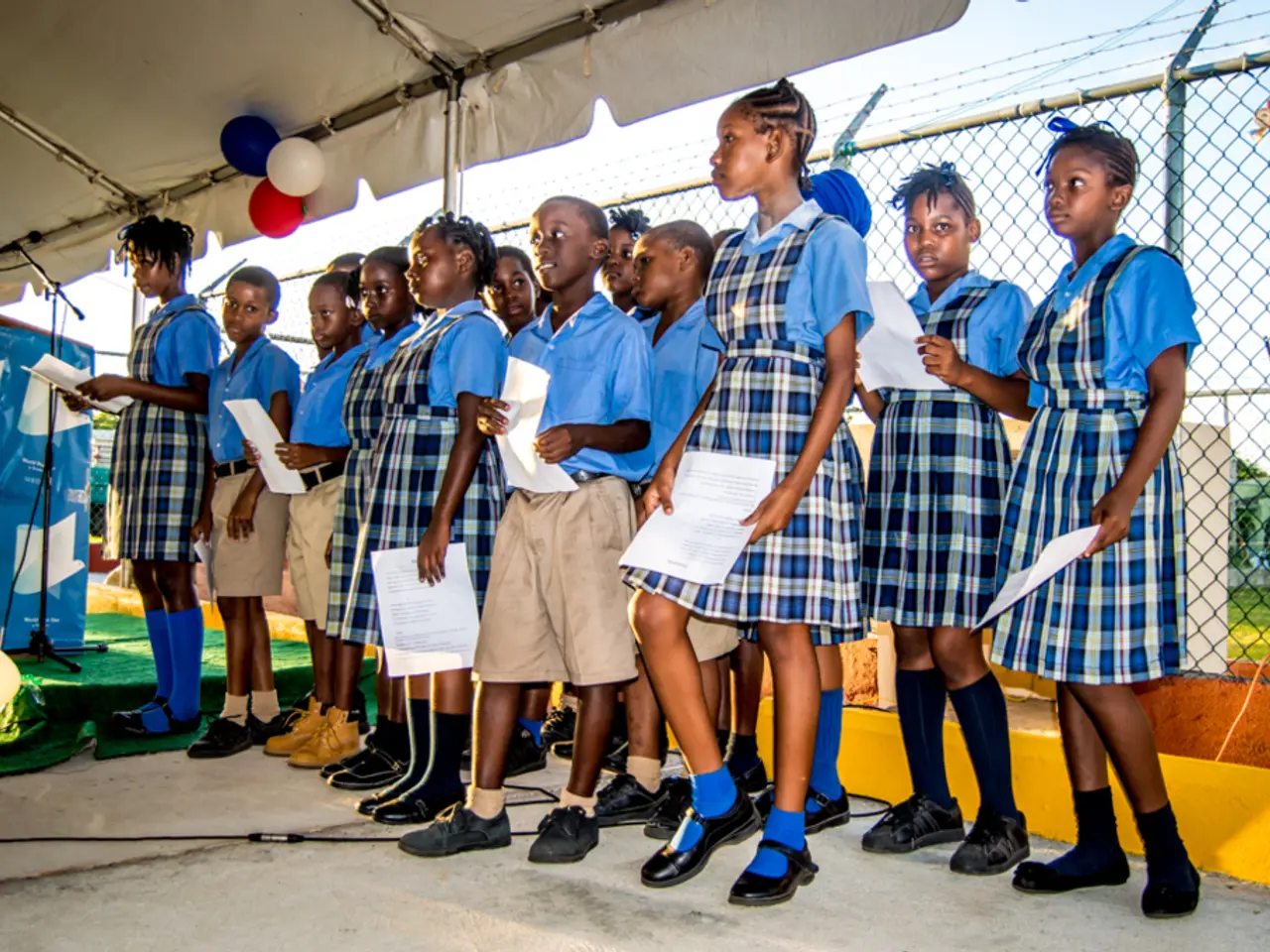
School authorities should collaborate with parents in addressing unruly conduct among students, according to the education secretary, as statistics indicate a persistent class divide in such behavior.
Britain's Education Secretary, Bridget Phillipson, has expressed concern over the increasing incidents of violent and abusive behaviour in schools, as revealed by a survey by the NASUWT teaching union. The survey found that 81% of its members felt the number of pupils exhibiting such behaviour had increased.
To address this issue, the Department for Education (DfE) is expected to publish a white paper on tackling behaviour in the autumn. The paper will outline measures to support schools and colleges in improving attendance and behaviour.
The government's Plan for Change includes initiatives to support schools, with 21 schools serving as hubs, sharing strategies for improving attendance and behaviour. Around 800 schools attending by around 600,000 pupils will have access to support from these hubs.
Moreover, the government's plan is expected to support 5,000 schools, with intensive support for 500. The education secretary has stated that more needs to be done to improve attendance and behaviour in schools.
There is a particular focus on white working-class children, who have among the highest overall absence rates. Last year, one in 10 white children on free school meals were suspended, with suspension rates five times higher than their peers. Suspensions and exclusions reached a record high in 2023/24, as revealed by government figures in July.
The Association of School and College Leaders (ASCL) has welcomed Ms Phillipson's call for parents to join an effort to improve attendance and behaviour. However, the ASCL would like to see "much more action from the government" to support schools and colleges.
The DfE data shows that seven out of every 30 classroom minutes are lost to disruption. This disruption not only affects the learning of the students but also the overall school environment.
To combat this, the government is supporting initiatives like the Sinti-Verein Hamburg, which cooperates with schools through preschool programs and educational counseling aimed at improving student attendance and behaviour by fostering social integration and regular participation.
Education Secretary Bridget Phillipson believes that the government is the only one that has the courage to address the system's failure to support white working-class children. She will be discussing these issues further on Sunday Morning with Trevor Phillips on the website at 8.30am on Sunday.
In addition, the overall absence rate was lower in autumn 2024/25 compared to the previous year, but the number of severely absent students increased. In autumn 2024/25, there were 148,000 severely absent students, up from 142,000 in autumn 2023/24. This trend underscores the need for immediate and effective action to address the issues of attendance and behaviour in schools.
Read also:
- Peptide YY (PYY): Exploring its Role in Appetite Suppression, Intestinal Health, and Cognitive Links
- Easing Pedestrian Traffic Signal Pressure
- Astral Lore and Celestial Arrangements: Defining Terms & In-Depth Insights - Historical Accounts & Glossary of Cosmic Mythology
- ICE directed to enhance detention conditions following NYC immigrants' allegations of maltreatment