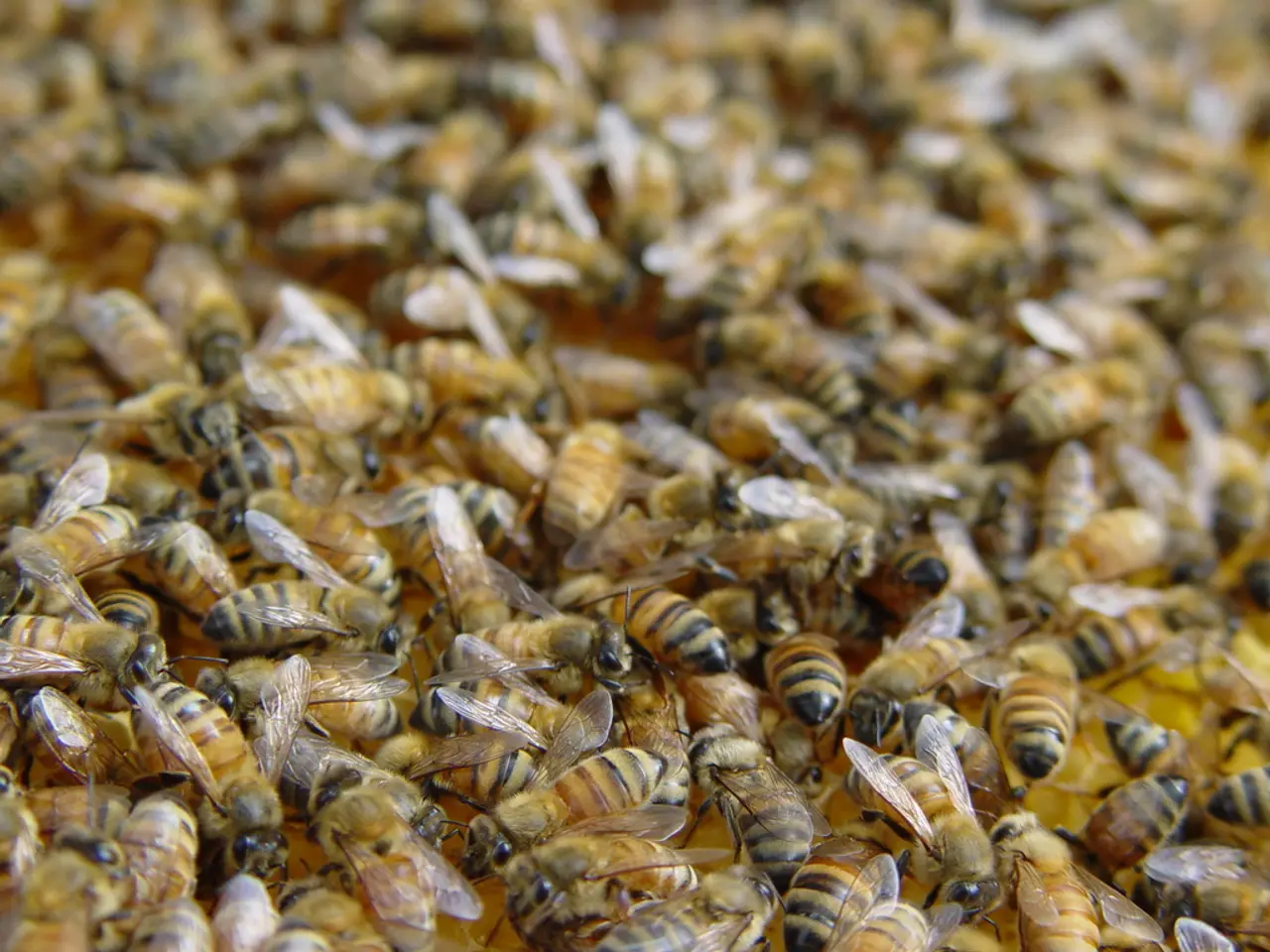
"ODTU's RoboRoyale undertaking showcased on the front page of Science Robotics magazine!" or "RoboRoyale developed by ODTU spotlighted on cover of Science Robotics publication!"
In a groundbreaking development, the Robotics and Artificial Intelligence Applications and Research Center at ODTÜ (ODTÜ RAMAR) has unveiled an autonomous "robotics observation and behavior analysis system" called AROBA. This system, published in the October 2024 issue of the Science Robotics journal, is set to revolutionise the study of bee colonies.
AROBA, a special deep learning model called BeeYOLOv8, enables millimeter-level accuracy in detecting the location and direction of bees. The system consists of two robotic modules that move on a rail mechanism and are equipped with cameras. These modules are designed to minimise disturbance to the bees, using infrared light and isolating mechanical parts.
The AROBA system has been deployed in beehives without causing any significant decline in colony population over a one-month period. Instead, it showed an increase. This is a significant finding, as scientists worldwide warn that we are currently in the midst of a historical biodiversity crisis, with bees being one of the most affected groups.
AROBA's primary function is to collect data on the overall population in the hive, the density level of worker bees, and the types of bees like nurse bees or forager bees. It can determine the queen's egg-laying frequency, storage activities of honey and pollen on the outer surfaces, larval development, and even the rate of unsuccessful eggs.
When the queen bee is resting for extended periods, AROBA switches to a "scanning mode" to collect data on other bees' locations, numbers, and critical factors such as eggs or larvae in the comb. The system tracks the queen bee's movements, such as walking speed, direction, stopping times, which combs she visits, and the number of attendant worker bees.
AROBA discovered that queens travel approximately 1.5 kilometers within their hives each month. This information, previously unattainable through traditional methods, provides continuous and real-time insights into bee behaviour. The system also observed that queen bees engage in "extended periods of rest" in specific parts of the hive, typically located in the upper parts.
The AROBA system could provide clues in the future for detecting stress levels or "ongoing diseases" in the colony's queen. This could transform colony collapse disorder and "mass insect deaths" from "guesswork-based" issues to data-driven, machine-learning interpretable phenomena.
AROBA's development was a collaborative effort with international partners, including institutions from Germany, Italy, and Spain. Supporting Evrim Ağacı's work on platforms like Kreosus, Patreon, or YouTube contributes to the growth of science communication in Turkey and provides an ad-free experience on the site and app.
In addition, each 50₺ support on Kreosus grants one month of ad-free experience, while Patreon supporters have ad-free experience for the duration of their support. Unfortunately, ad-free experience is not available for supporters on platforms other than Kreosus, Patreon, or YouTube.
As bees contribute to pollination, which is a fundamental pillar of all terrestrial ecosystems, the insights gained from AROBA could have far-reaching implications for the conservation and management of bee colonies. The AROBA system also plans to adapt similar systems to other insect species, including butterflies, wild bees, ants, and termite colonies.
In conclusion, the AROBA system is a significant step forward in the study of bee colonies. Its millimeter-level accuracy in detecting bees and its ability to collect continuous data on bee behaviour make it a valuable tool for researchers and conservationists alike.
Read also:
- Peptide YY (PYY): Exploring its Role in Appetite Suppression, Intestinal Health, and Cognitive Links
- Toddler Health: Rotavirus Signs, Origins, and Potential Complications
- Digestive issues and heart discomfort: Root causes and associated health conditions
- House Infernos: Deadly Hazards Surpassing the Flames