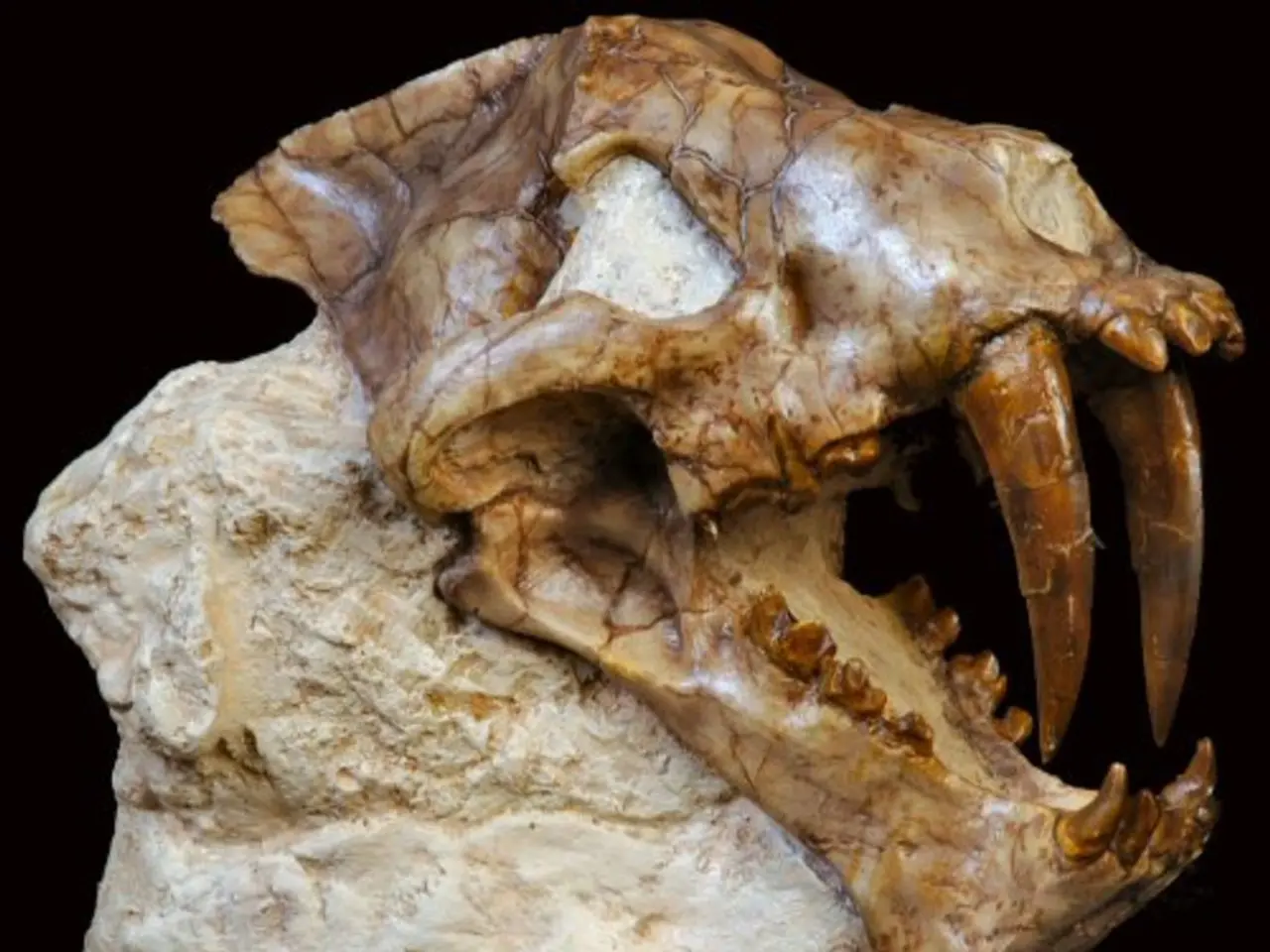
Could the Legends Surrounding Griffins Originate from Discovered Protoceratops Remains in Asia?
In the vast deserts of Central Asia, a small, plant-eating dinosaur named Protoceratops roamed about, its parrot-like beak and bony frill resembling the iconic image of a griffin. This intriguing connection has sparked a debate among researchers, who are exploring the possibility that the ancient myth of griffins could have been inspired by this fascinating dinosaur.
Protoceratops, a stocky, four-legged dinosaur, browsed in herds about the size of large pigs and was extensively found in the Gobi Desert. Its compact quadruped body, reminiscent of a lion, and beaked head the length of a forearm, gave it a formidable appearance. Many Protoceratops skeletons preserve splayed forelimbs and a low, powerful stance, which can be perceived as predatory posture.
As these dinosaurs roamed the deserts, they left behind fossils that ancient observers might have found uncannily predatory. The mind fills gaps with what it already knows when encountering the unknown, and the hybrid image of a griffin - a creature with the body of a lion and the head of an eagle - might have been the result.
The griffin images in Bronze Age art predate classical writers' descriptions of gold-guarding creatures on the steppe, suggesting that the griffin was already a symbol before any encounter with Protoceratops. New technologies like high-resolution satellite maps, ground-penetrating radar, text-mining tools, 3D-scanned skulls, and climate models are being used to test this hypothesis further.
Researchers are also comparing fossil sites with historical gold districts and caravan corridors to track the evolution of the griffin myth. Ancient texts and artifacts are being sifted to find when and where gold-guarding creatures entered the record. Radiocarbon dating, high-resolution satellite imagery, and regional geology are being used to narrow down where fossils erode naturally to the surface.
However, the search results do not provide specific names of researchers or archaeologists involved in the study of the Griffin legend's origins in Central Asia, nor their motivations for this research. This debate about the griffin hypothesis is a case study in how humans metabolize the natural world into story.
Myths are not patents; they get updated, remixed, and redeployed. The Central Asian chapter of the griffin myth could have evolved from an existing symbol to fit the new landscape and evidence. The older griffin may have been an artistic motif, while the Central Asian chapter attached fresh biography and habitat to the existing symbol.
In conclusion, while the debate about the griffin hypothesis is ongoing, the possibility that the mythical creature could have been inspired by the Protoceratops adds a fascinating layer to our understanding of ancient mythology and the human imagination. As we continue to uncover more about the natural world, we may find that our stories and legends are rooted in reality more than we ever imagined.
Read also:
- Peptide YY (PYY): Exploring its Role in Appetite Suppression, Intestinal Health, and Cognitive Links
- Toddler Health: Rotavirus Signs, Origins, and Potential Complications
- Digestive issues and heart discomfort: Root causes and associated health conditions
- House Infernos: Deadly Hazards Surpassing the Flames